+1 647-560-2411
Plan a speed networking event by defining your audience, choosing a structured format, setting clear timing, selecting a flexible venue, promoting early, and organizing post-event follow-up. Focus on smooth logistics and meaningful connections to ensure attendees leave with valuable professional relationships.
Turns out, six seconds is all anyone needs to size you up. Research suggests people can form detailed, surprisingly accurate impressions almost instantly, even from short, silent video clips.
At speed networking events, that’s your entire window. The format is designed to make every moment count, giving attendees a structured, energetic environment to meet more people, make stronger impressions, and walk away with connections that matter.
How can you, as an event planner, build a speed networking event that delivers on that promise? We have tips, steps, and strategies for you.
A speed networking event is a structured, time-based format in which attendees rotate through one-on-one (or small-group) conversations over a set period. Think speed dating, but for your career, business, or creative community.
The goal is to:
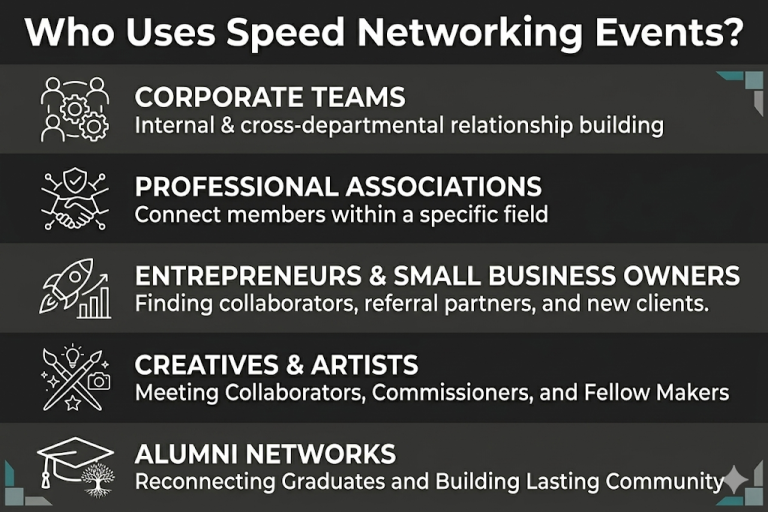
Image Source: Gemini 2026
Speed networking events can be structured as a one-on-one rotation, a group rotation, a free-form open floor, or a hybrid, depending on your headcount and the dynamic you want in the room.
Here’s a quick breakdown of the most popular speed networking models or formats:
| Format | Description | Optimal Seating System | Ideal Venue Type |
|---|---|---|---|
| Round-Robin Model | Two fixed/rotating rows. Best for 20-60 people needing one-on-one depth. | Numbered chairs or tables in two parallel rows | Open-concept floor plan with movable furniture |
| Group Rotation (Group-based speed networking) | Small groups rotate by topic. Ideal for 60-200 guests; lowers individual pressure. | Clustered tables with category signage | Large, zonable spaces |
| Hybrid Open Networking | Round-robin followed by open mingling. Good for 200+ guests. | Rows for structured rounds, open floor after | High-capacity venues with configurable layouts |
| Themed Tables (Station-based speed networking) | Topic-specific stations. Attendees rotate by interest. Best for groups under 20. | Labelled stations arranged around the perimeter or in clusters | Intimate, private function or dining halls |
To organize a speed networking event, you need to prepare the following: objectives, participants, a program/run-of-show (format + timing), logistics, a venue, and a promotion strategy.
Here’s how to nail all of them:
Before you book a venue or design a schedule, get clear on what success looks like. A speed networking event for senior executives looks very different from one for early-career creatives or small business owners.
Ask yourself:
Tip: Send a pre-event survey to registered or potential attendees asking what they most hope to get out of the evening. The answers will instantly sharpen your program, prompts, and room setup.
Speed networking events work best with 20 to 200 people, but you can make it work at any size as long as you scale the format to fit. Keep to even numbers, and ensure equal participants per rotation group for smooth flow.
You also want to ensure you have the right venue for your numbers, one that can flex to your format without feeling empty or overcrowded. More on this later!
Define the round length, buffer time, and total duration, then build your entire evening around them. These serve as the main drivers of your event.
Consider the following when organizing the time in your speed networking session:
| Tip: Reminds guests when it’s almost time to move on with a signal system, so they can wrap up their conversations neatly. This can be a bell, chime, projected timer, or a live emcee. Make sure every corner of the room can hear or see it clearly. |
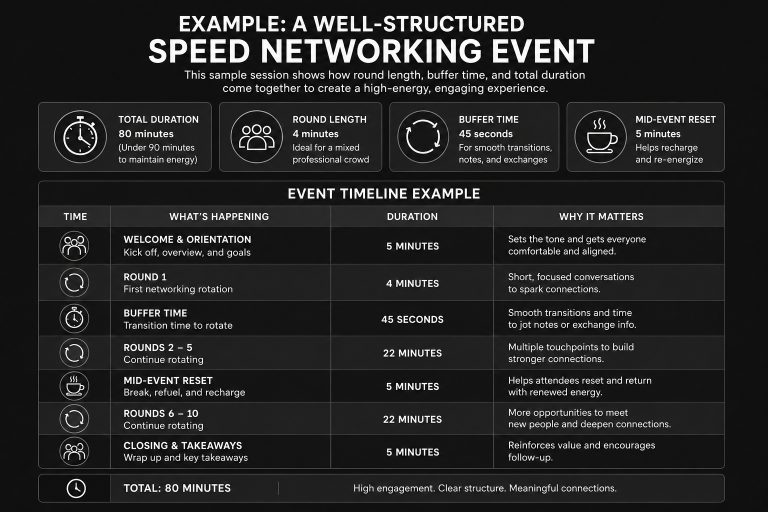
Image Source: ChatGPT, 2026
A great venue should get people in the door, keep them comfortable, and let your format logistics fade in the background. Speed networking events are mostly program-driven, but a bad space can ruin even the best program in the world.
To ensure a successful speed networking event, choose a venue with:
| Tip: For larger events, book multiple spaces in the same building, e.g., one floor for structured rounds and another for open mingling. Venues like The Loft on King offer multiple event spaces (including an indoor/outdoor rooftop!) so you can run a full, varied evening without anyone leaving the building. |
A well-timed event promotion strategy reaches more professionals looking to make valuable connections. The earlier you start promotions, the wider the reach. Most corporate events push promotions four to 12 weeks ahead for smaller events, or three to five months ahead for larger events.
However, recommended lead times depend on your situation and your attendees.
| Your Situation | Suggested Lead Time | Why |
|---|---|---|
| Established audience or email list | 4–6 weeks | Familiar network only needs enough notice to clear schedules. |
| New event, no existing audience | 10–12 weeks | Building awareness from zero; requires time to build awareness before sign-ups. |
| Niche or industry-specific event | 8–10 weeks | Smaller, targeted audiences take longer to reach; partnerships and referrals are key. |
| Large-scale event (100+ attendees) | 10–12 weeks | More logistics and coordination with sponsors and partners; requires more lead time. |
| Repeat or recurring event | 3–4 weeks | Past attendees already trust the format; a reminder is usually enough. |
| Free event | 4–6 weeks | Lower commitment barrier means shorter decision cycle, but don’t wait too long. |
| Paid or ticketed event | 8–10 weeks | People need more time to justify a purchase; early bird pricing helps drive early sign-ups. |
Promote your speed networking events in the following channels:
| Tip: Create an FAQ section to address common queries like rates, registration details, and day-of requirements. Removing friction upfront increases sign-ups. |
Ideally, you want to build follow-up into the event itself. Some organizers create a shared spreadsheet or Notion page where attendees can list their name, company, and what they’re looking for, turning the event into an ongoing resource.
If you’re running a recurring event series, a follow-up email is an effective way to drive registration for the next one. Send a follow-up email to all attendees within 24 to 48 hours with:
Pre-matching attendees, handing prompt cards, adding industry tags to badges, and leading a “hot seat” round are a few speed networking event ideas your guests will appreciate. Other ways to elevate your speed networking events include:
Common formats include:
Send a follow-up email within 24 to 48 hours with a thank-you note, community group link, resources, a feedback survey, and a teaser for your next event. You can also build follow-up into the event with a shared spreadsheet or curated recommendations.
We’d love to help you pull it off! The Loft on King’s 1,850 sq. ft. venue offers flexible layouts, strong acoustics, in-house catering, and built-in A/V, making speed networking events easy to run and enjoyable to attend.
Book a venue tour today to see how we can make your events come to life.

7 Benefits of Hosting a Product Launch Event

Contact us now to book a site visit, and see what our unique 4 floor venue has to offer.